
 English
  Magyar
Villányi Wine district

History | National Geography

Vineyards | Origin protection

History
Villány, the wine region’s main town, was already inhabited in prehistoric times. The first artifacts found in the area date back 7,000 years, while the origins of viticulture can be traced back to the Celts and, verifiably, to the Romans. The fascinating Roman villa ruins found near Nagyharsány and the altar stone depicting viticulture found there demonstrate the long-term presence of the Romans and the advanced nature of their viticulture. In the centuries following the fall of the Roman Empire, the area was mainly populated by Avars, as evidenced by the 7th-century Avar graves excavated near Nagyharsány.
After the founding of the Hungarian state in the 10th century, the settlement was probably royal property. Following the Mongol invasion in the 13th century, King Béla IV was the first to mention the vineyards on the edge of Nagyharsány in the founding charter of Szársomlyó Castle. During the Turkish conquest in the 16th century, Turkish commanders from Pécs and Siklós extended their power over the region, settling Slavic (Rác) populations there during this period. They are believed to have brought the Kadarka grape variety with them and laid the foundations for Villány’s red wine culture. A decisive battle took place near Nagyharsány in 1687, resulting in the expulsion of the Turkish troops from Hungary. Contemporary records show there were only 1.6 acres of vineyards in Villány at that time, which had grown to 20 acres ten years later. In 1699, most of the region became the property of the famous military commander, Prince Eugene of Savoy, who received it from Emperor Leopold I in thanks for his services. Conscious management resulted in around 65 acres of vineyards by 1720, most of which were manorial vineyards. The rest were cultivated by serfs.
From the end of the 17th century onwards, increasing numbers of people of different nationalities – mainly Germans – were settled in the country to replenish the Hungarian population, which had shrunk under Turkish rule. The arrival of Germans in Villány, beginning in the 1730s, marked a decisive turning point in the region’s wine production. On the one hand, their expertise and diligence enabled qualitative change, on the other, the settlers brought Portugieser with them. The speed of development is also demonstrated by the fact that the cellars in Villány were built around 1740, while those in Palkonya and Villánykövesd were built continuously from 1760 onwards. By 1785, there were already around 80 acres of first-class vineyards.
Thanks to the 19th-century reforms (1851), grape cultivation began to develop further. The proportion of Germans continued to grow, and by 1865 there were already 376 acres of vineyards in Villány. Development only interrupted by phylloxera. Replanting progressed slowly for professional and financial reasons, so it took twenty years for the Villány vineyard area to reach its 1894 size.
Although the peace treaty that ended World War I (1920) left the region in Hungary, it cut it off from a large part of its markets. The economic crisis that erupted in the late 1920s greatly worsened the situation for producers. The boom began again in the 1930s, with wine production quadrupling between 1934 and 1939 (from 2,200 hl to 8,000 hl). Production grew steadily until the outbreak of war, stagnated during the war (Villány also supplied wine to the army), and declined sharply in the war’s final years.
After World War II, most of the German population was displaced under the principle of collective guilt. Those who remained at home lived in increasingly deteriorating economic and social conditions and, for decades, could only use their native language among themselves. New settlers arrived to replace those who had been displaced but did not understand viticulture, so many new growers went bankrupt. For a long time, socialist large-scale cultivation did not allow for individual estates.
After the collapse of communism, local private producers began to rise to prominence in the early 1990s, becoming the first star winemakers and winning the Winemaker of the Year award one after another (Ede Tiffán in 1991, Attila Gere in 1994, Zoltán Polgár in 1996 and József Bock in 1997). Starting in the 2000s, vineyard reconstruction began across almost the entire wine region, while the legendary Villány wine tourism was established. The latter still has huge economic impact to this day. This also led to significant external capital investments, interestingly, typically with Hungarian backing. A new local generation also emerged, some of whose representatives had joined the most respected names by the 2020s. The wine region introduced its own system of origin protection in 2005 and then created its own brand, Villányi Franc.
Natural Geography
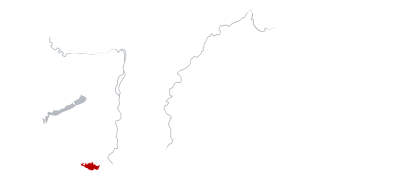
Villány, together with nearby Siklós and its surroundings, is Hungary’s southernmost wine region. If you were to fly over it in a hot air balloon, you would be treated to an interesting sight. The barren rocky mass of Szársomlyó Hill rises on the northern side of Villány, while further south, the landscape flattens out, stretching all the way to the Drava River, which winds its way through Croatia. You can see the approximately 25-kilometre-long, cca. 2,200-hectare wine region with vineyards stretching across its southern and eastern slopes.
The terrain and fault lines of the limestone mountains formed in the Mesozoic era provide ideal topography for the development of a unique sub-Mediterranean climate by blocking cold air masses coming from the north. The Villány Hills are composed of carbonate rocks deposited in the seas of the Mesozoic era. These include Triassic marl and dolomite, as well as Jurassic and Cretaceous limestone. The bedrock is covered by several metres of loess, while the slopes of the hills are covered by lime-rich loess and clay of varying thickness.
Triassic limestone, with no geological formations from the Tertiary period, dominates on the western side (Siklós). The bedrock here is covered directly with sandy loess, which also provides the soil for the vineyards. This topsoil is rich in calcium, making it suitable for producing wines with plenty of acidity, while pure loess soil produces soft wines. There are several types of limestone between the layers. The lowest, or oldest, layer is clayey dolomite from the Middle Triassic, overlain by a layer formed in the Upper Triassic. After this, the area was presumably dry land for a long time, as the next layer was formed in the Early Jurassic period. Next comes the Villány Limestone, formed 160 million years ago and internationally famed for its rich ammonite fauna. The youngest member of the stratigraphic sequence is the Szársomlyó Limestone. This grey limestone, poor in fossils, became known for its karst cave fillings, which contained a mass of mammal bones dating back 2 million years (i.e. from the early Pleistocene).
The region’s climate is influenced by three main airflows: continental, Mediterranean and oceanic. The southern slopes are primarily influenced by the Mediterranean climate. Spring arrives earliest in Hungary here, and the number of sunshine hours is well above the national average. During the growing season, this means an average temperature of 17-20°C, an active heat summation of 2,000-2,200°C and annual precipitation of 650-900 mm.
Vineyards
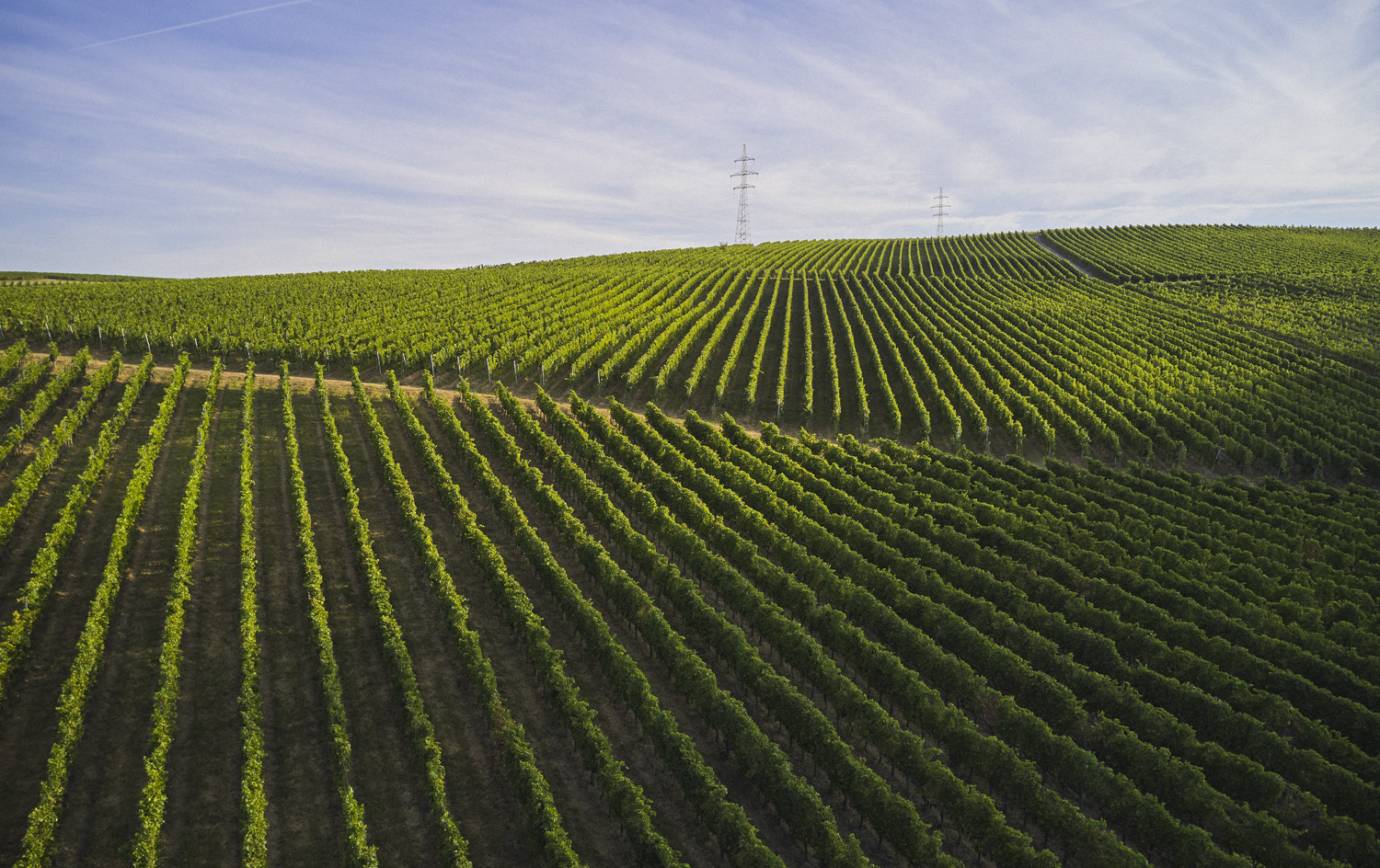
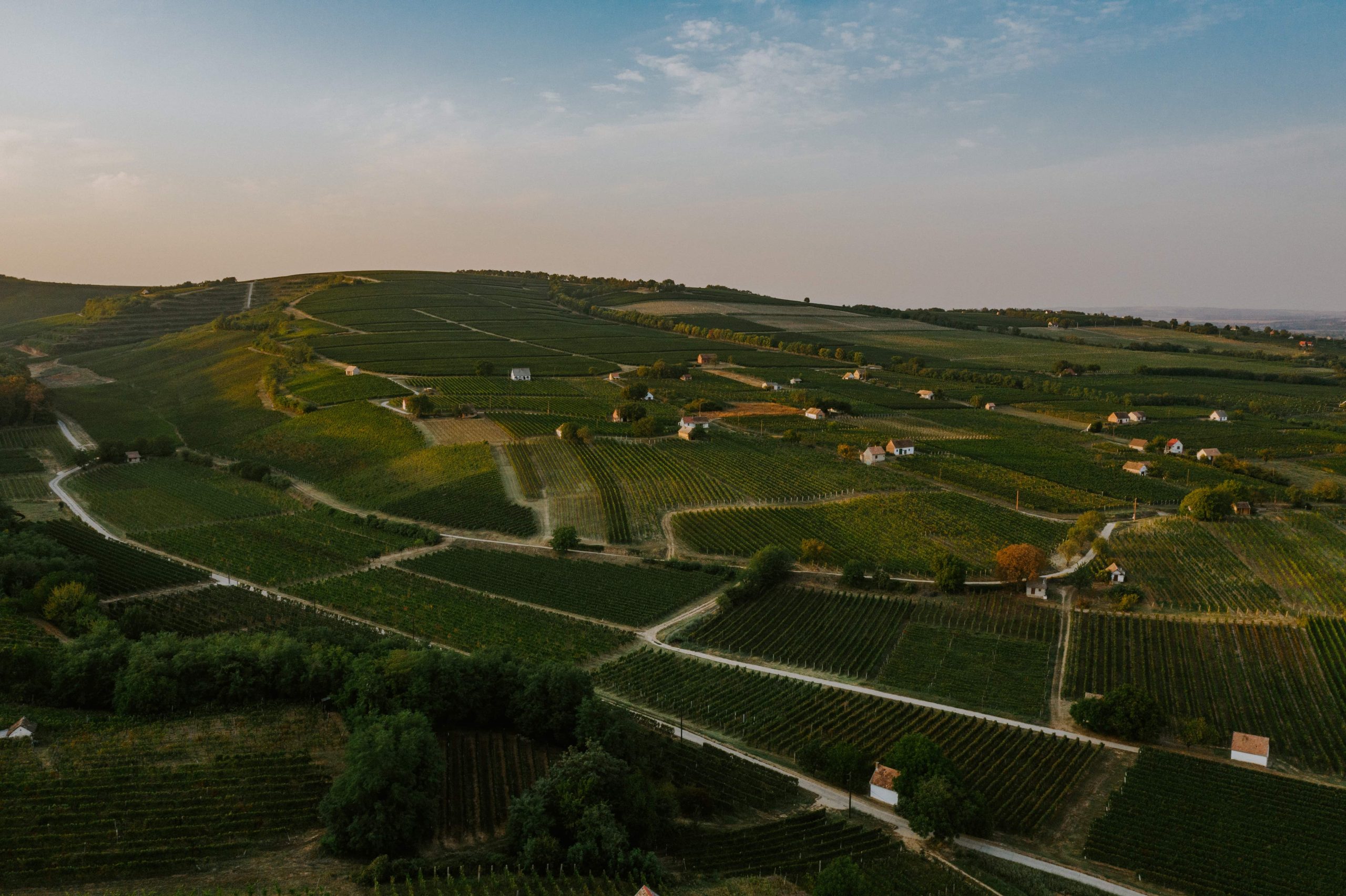
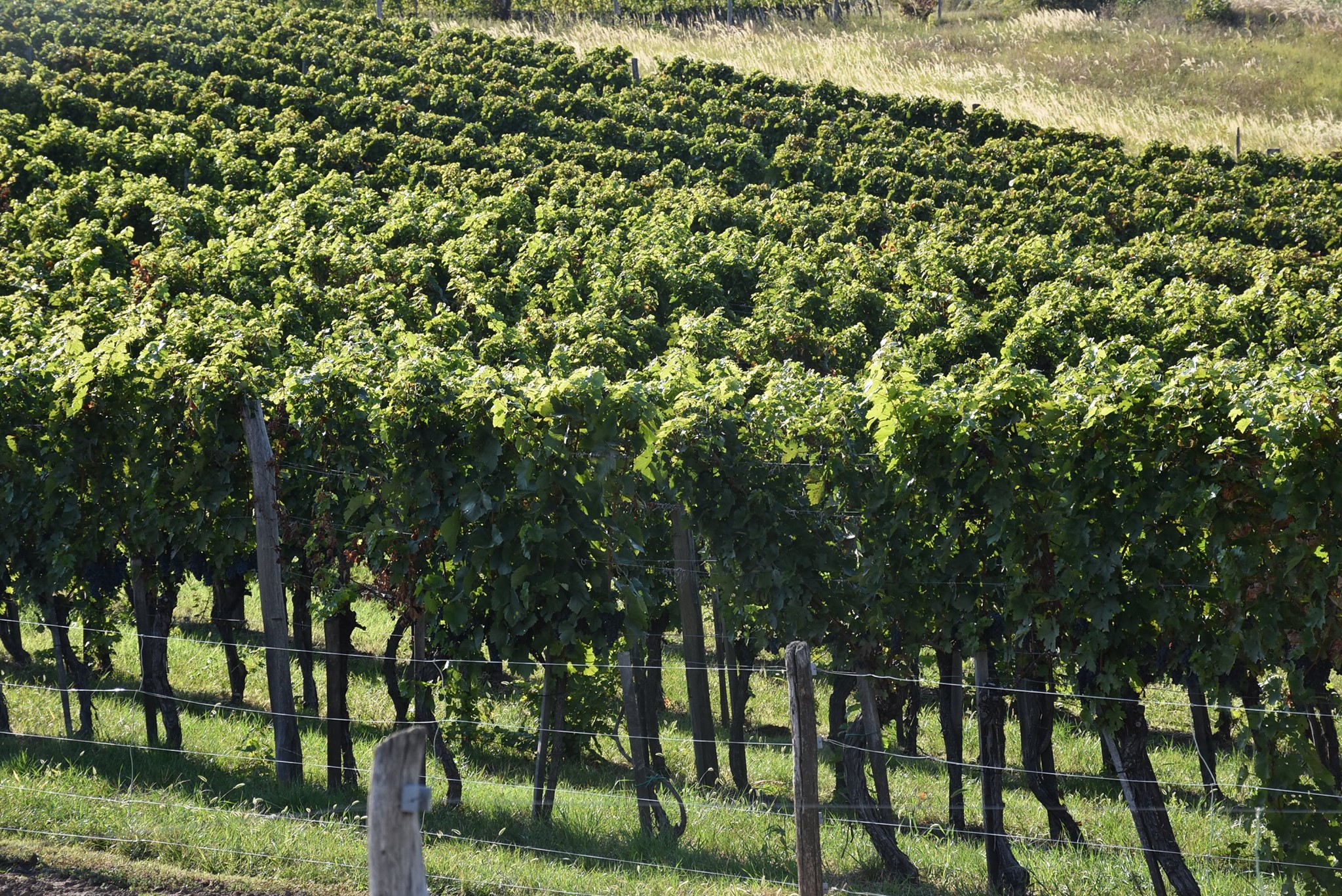
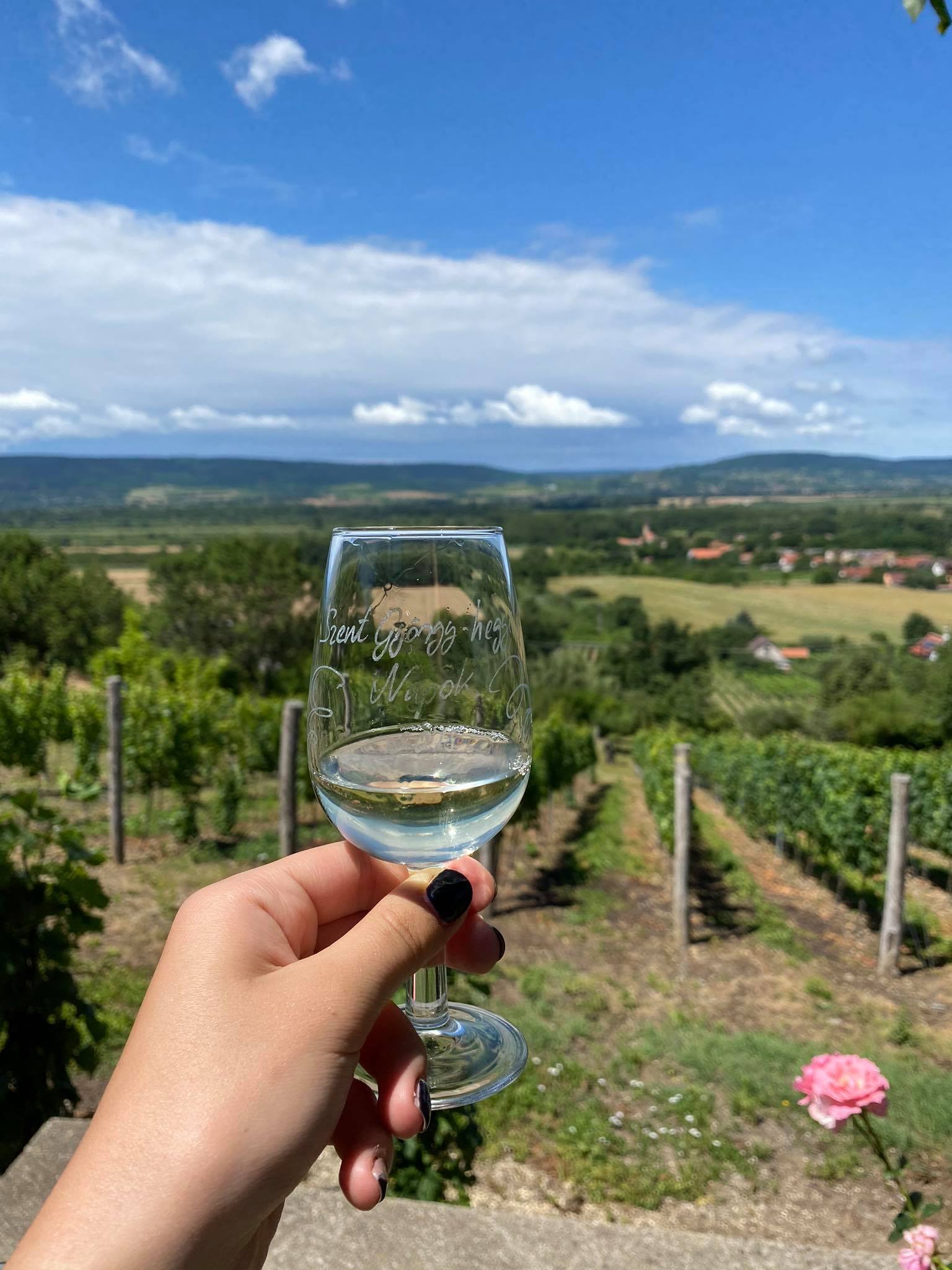
Villány is a small wine region, but one glance at the map and a single visit are enough to conclude that it is Hungary’s most concentrated. The entire landscape is covered with vineyards, with only a few breaks in the rows of vines for forests, scrubland or cereal crops. Moreover, this vineyard landscape is incredibly well maintained, on a par with the world’s most desirable wine regions.
Logically, the wine region can be divided into three parts. This logic is obviously based on the geography of the vineyards, but economic considerations also play a significant role. Starting from the east, the first logical unit is Villánykövesd, Villány and Nagyharsány, which is differentiated by a slightly thicker layer of loess as well as economic conditions. This is due to outstanding local producers settling here and instinctively acquiring their first parcels of land based on inheritance and rights of first refusal on neighbouring land.
The second logical unit stretches from Kisharsány in the east to the western end of Máriagyűd. This is commonly referred to as the Siklós section, where the loess cover thins out in places and the wines in certain areas have greater acidity. Thus, some white grape varieties thrive here. (Their surface area decreased significantly for a while, as the wine region had achieved considerable success with red wines, with climate change also reinforcing this process. However, this has been halted due to changes in consumer habits in the 2020s, and the wine region is once again producing increasing quantities of white wine.) The wineries that own vineyards here are mostly second-generation Villány producers and outside investors, broadly speaking those who were unable to acquire large vineyards in the eastern part of the region.
The third unit is the westernmost part, which includes villages such as Csarnóta and Diósviszló. These areas also boast excellent terroirs, which are being eagerly cultivated by the younger generation, resulting in very high-quality wines. Nevertheless, the wine region has not yet seen fit to designate more vineyards on the western side within its PDO system.
Villány and Nagyharsány
As already mentioned, the wine region can basically be divided into three main parts. The easternmost part stretches from the western end of Szársomlyó to the eastern side of the wine region, with the easternmost vineyard being the aptly named Calcberg and the westernmost Dobogó, located on the border between Nagyharsány and Kisharsány.
Perhaps surprisingly, the town of Villány has only five vineyards. Besides the previously mentioned Calcberg, the most famous is undoubtedly Jammertal, which was perhaps the first vineyard name to become widely known in connection with the wine region. It begins directly above Hunyadi Street, the last street on the hillside, although it is inaccurate viticulturally to also refer to the garden vineyards located here as Jammertal. Jammertal stretches all the way to the top of the hill, where the small Sommsich (Somsics) vineyard closes off the wine region from the north. The Csillag-völgy (Sterntal) vineyard merges completely with Jammertal, with no spectacular terrain features separating them. However, the case of Ördög-árok is particularly interesting, as this vineyard lies at the meeting point of three wine communities. Villány is obviously one of them, but it also extends into the cadastral areas of Villánykövesd and Nagyharsány, with the latter having the largest area.
It is worth mentioning Villánykövesd here. There are only vineyards to be found on the southern and western edges of the village, the former being mostly the Agancsos vineyard and the previously mentioned small Ördög-árok vineyard. Ördög-árok is definitely the wine region’s most impressive vineyard. Its cultivation began in the early 2000s with the cooperation of Villány’s best-known producers. The surrounding hills were significantly transformed through land improvement, creating a natural environment that amazes visitors today, especially in summer and autumn. Slopes of 20-25% and terraces add variety to the vineyard is some places, while its basin-like morphology means that the wines produced here can vary considerably depending on the area’s exposure.
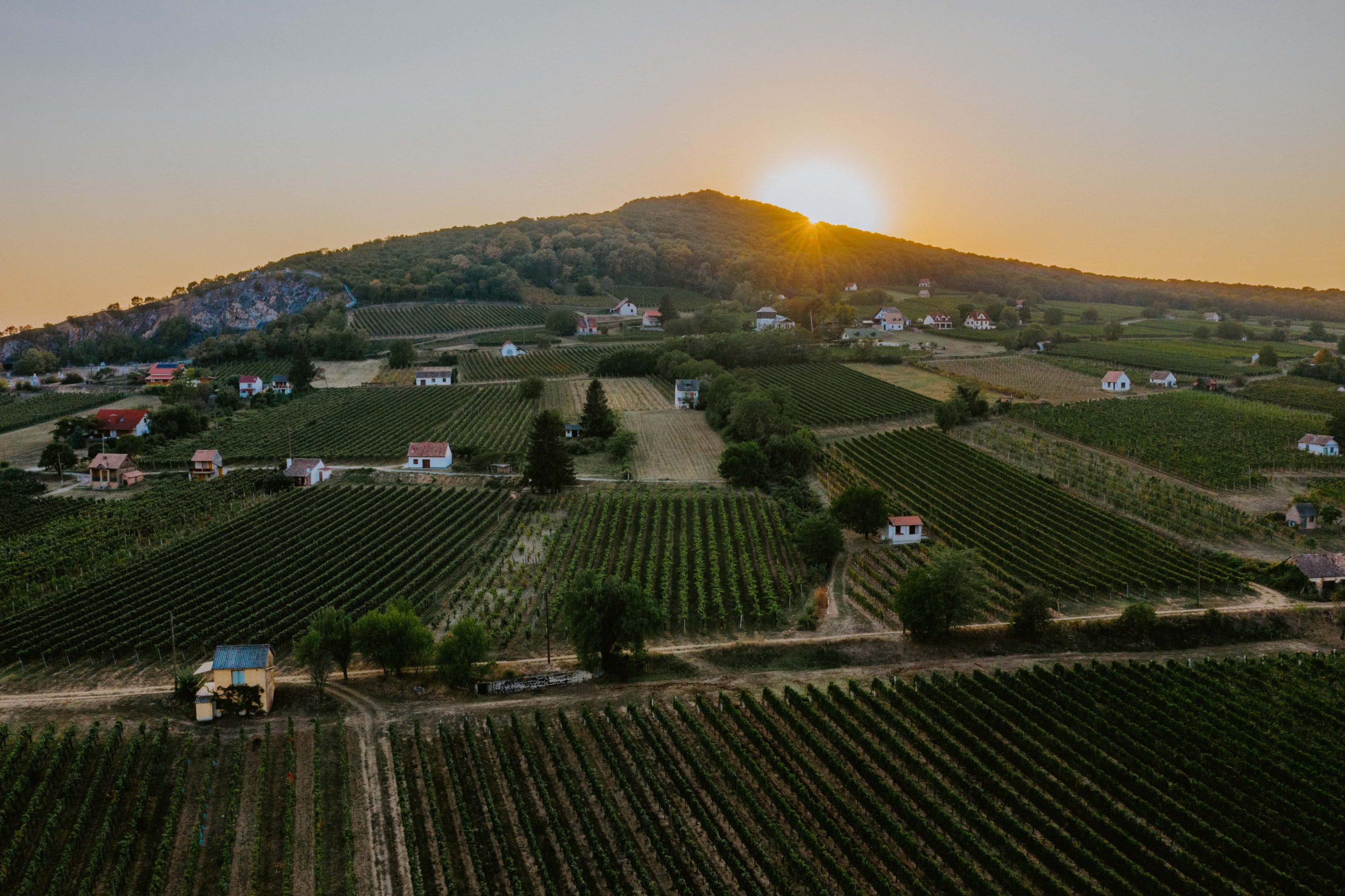
Nagyharsány is perhaps the wine region’s least distinctive village, yet it boasts the most renowned vineyards on its outskirts. Szársomlyó Hill, a nature reserve with two vineyards to its south, belongs to the village. One of them, Dombi-dűlő, is not very significant and is currently mostly covered by arable land. The other, Kopár, is, however, the most famed vineyard name in Hungary and the country’s southernmost vineyard. Its reputation was established by some of the most renowned producers with their iconic red wines, so it is hard to believe today that before the collapse of communism, it was mainly planted with Olaszrizling. The last years of the 20th century saw the beginning of a major wave of planting, which only came to an end in the early 2010s. Kopár is undoubtedly the warmest vineyard in the country, thanks to the hill towering above it, with its rocks reflecting heat like a mirror. The topsoil gradually becomes thinner as you go up the hill, while the bedrock is exposed at the top, so the vines here are smaller but yield more mineral-rich grapes. Kopár consists of three “levels”, the lowest of which is the lower slope that stretches above the road to Nagyharsány and consists of relatively small parcels. The middle section was planted with black grapes before the regime change – in rows perpendicular to the slope, except for the easternmost section, where the two lower levels were planted in 2009-2010 by the largest winery in the wine region, with rows running down the slope. The third level was planted by the big Villány names in rows sloping downhill and is the most well-considered and spectacular. Kopár certainly has one of the most exciting soil structures in the wine region, with a particularly varied limestone subsoil, and the influence of the soil is evident in the wines. One disadvantage to the vineyard, however, is its altitude, as the lowest part of the vineyard is below 100 metres, meaning these areas are very susceptible to frost. It is important to note that the westernmost part of Kopár, which stretches above the village of Nagyharsány, is commonly referred to as Szarkás, and is considered by many the best red wine parcel in the country.
The other Nagyharsány vineyards lie north of Szársomlyó. Besides the previously mentioned Ördög-árok, there are also Konkoly, Fekete-hegy, Várerdő and Dobogó, all of which are also capable of producing independent, single-vineyard wines. Konkoly is a very steep, south-west facing slope north of Szársomlyó, with a soil cover of loess, red clay and Triassic dolomite. The latter is also visible in fist-sized pieces on the surface. Due to its very warm climate, it is primarily home to Bordeaux grape varieties. The Fekete-hegy vineyard, located directly to the west, is a gently sloping, almost entirely south-facing area, while the Várerdő vineyard to the south is a completely different story. This vineyard is located on the northwestern slope of Szársomlyó, so its microclimate differs drastically from that of other vineyards in the wine region. The cooler areas with less exposure to the sun and more vegetation were quickly discovered by producers wanting to plant varieties requiring less heat. Accordingly, Portugieser, Kékfrankos and Pinot Noir were mostly planted here. The last vineyard in the group is Dobogó, which borders the eastern edge of Kisharsány and is very similar to Fekete-hegy in terms of its slope.
From Kisharsány to Máriagyűd
Kisharsány is one of the most important wine communities in the wine region, but it only has four vineyards, one of which is Hegyalja. It was created by splitting Dobogó in two, to such an extent that it is practically impossible to separate the two visually or by landmarks. There are two important vineyards on the other side of the road leading northeast from Kisharsány. The most northern is Hársos, which is almost entirely owned by the largest winery in the wine region and is a gently sloping area with full southern exposure. Bocor is a particularly exciting vineyard, which has produced several single-vineyard wines over the past decade. Starting from the hilltop, it extends to the southeast, south and southwest, with a small basin in the middle. This central part has been planted by several well-known Villány producers since 2006. Its soil is slightly calcareous, and it reaches an altitude of 250 meters above sea level. The shape of Hajdus is quite surprising, as it was created by merging several vineyards. It mainly includes the areas above the road between Kisharsány and Nagytótfalu, and interestingly, the vineyard also extends into Nagytótfalu’s territory.
Nagytótfalu’s vineyards are very diverse. Some of them lie on flat land south of the village, while the vineyards on and between the hills to the north are very exciting. Three of them are already familiar to consumers through single-vineyard wines. The first is Gombás, which boasts almost entirely eastern exposure, with a minimal western slope. It is cultivated entirely by one large winery in Kisharsány, and due to its exposure, is largely planted with Pinot Noir. The other two vineyards are closely related to those discussed in Siklós. Mandolás and Pillangó are only separated from the Siklós vineyards by the road to Vokány, with hardly any differences in soil and microclimatic characteristics. This vineyard has become more valuable in recent decades due to its gentle, not overly steep southern slope, favourable wind conditions and elegant terroir character. These two vineyards reach up to around 220 metres above sea level, so there is no frost risk.
The Siklós vineyards are on the other side of the Vokány road. There is a total of five vineyards here that are collectively appreciating in value. Besides the two already discussed in connection to Nagytótfalu, these are Városhegy, Zuhánya and Makár. Their characteristics and wine structure are very similar to the other two, the most important common feature being a delicate minerality, which is only clearly present in a few places in the wine region. Városhegy can be divided into two parts: a slightly steeper section facing south, which is shared by many small producers, and the top of the slope, rising to over 200 metres, where large wineries have plantings. The easternmost part of this section slopes toward the road in an easterly direction. The vineyard immediately to its west is Zuhánya. It is not only incredibly exciting in name, but in terms of soil characteristics, it is perhaps the wine region’s most distinctive vineyard, boasting marl and limestone gravel. It also has good water permeability, so the roots of the vines never get waterlogged. The topsoil is moderately thick, allowing the vines’ roots to reach the subsoil, giving the few wines produced here a delicate minerality. Besides many small parcels, there are two large planted areas and an unplanted area of around 15 hectares at its heart. With its 20% slope and reputed soil composition, this could be one of the best in the entire wine region, so it is a pity it has not been planted, despite earlier ambitious plans. Makár is also one of the most exciting vineyards in the region. On the map, it appears to be south facing, but this is not the case. On the western side, it gradually descends over two kilometres from a height of 330 metres to its easternmost point at around 200 metres. It consists of two large wings. The western wing was developed by a renowned winery in the 2000s, while the eastern one is slightly more fragmented, although still dominated by large plots. Its soil is one of the most limestone-rich in the wine region, lending the wine distinctive, elegant terroir characteristics.
From Máriagyűd to Hegyszentmárton
The vineyards of the wine region’s other wine communities are still largely unknown to the public, as single-vineyard wines are rarely released from them. The Köves-föld vineyard is located on the edge of Máriagyűd; however, this now well-known vineyard belongs to Siklós. Although located on the hill’s lower slopes, its terroir characteristics are surprisingly distinct due to the calcareous soil, and, moreover, elegant. It covers a good 50 hectares, faces almost entirely south, and rises from an average height of 110 metres to 140 metres.
Sóta is a small vineyard, barely 20 hectares in size, located a little further away from everything else. It was also planted in the 2000s by an up-and-coming winery, with completely western exposure. The entire vineyard overlooks the Siklós-Pécs main road No.56 and belongs to the municipality of Túrony. Its highest point is around 230 metres.
The two westernmost named vineyards in the wine region are Csikorgó, located on the edge of Diósviszló, and Nagy-hegy in Hegyszentmárton. Both are quite large and divided into small and medium-sized parcels. With an average altitude of around 150 metres, they seem to be excellent production areas, but unfortunately, no single-vineyard wines appear to be made.
Origin protection
Sometime around 2004-2005, the wine region realised that, following its market success, it was now necessary to protect its renowned name and ensure that local producers worked according to a conceptual system. The first regulation was issued in 2005 and became mandatory from the 2006 harvest onwards. The now recognised crocus emblem could be seen on bottles starting with this vintage. Then, in the early 2010s, an EU programme required that all wine regions establish protected designations of origin, which led to the creation and implementation of the first regulations, known as product specifications, on 1 August 2012.
The wine region largely used its existing regulations as a basis for this original production specification, as they had already defined the two most important elements, namely the classic and premium product families and the associated production rules. However, the 2012 product specification defined the rules and average yields in much greater detail and not only considered the production of white, rosé and red wines but also semi-sparkling and sparkling wine. It also defined something that has remained unchanged ever since: the 37 vineyards that could be named – at that time exclusively on the labels of premium wines.
At the same time, there was also a different way of thinking, which was centred around grape varieties. Portugieser is the region’s traditional grape variety, boasting the most plantings before the collapse of communism. The 1990s brought the renaissance of Cabernet Sauvignon, yet since it rarely ripened fully until the mid-2000s, Merlot and Cabernet Franc gained popularity, which was clearly reflected in wineries’ varietal selections. Then one event caused a fundamental change.
One of the world’s most renowned wine writers, Michael Broadbent, wrote in the November 2000 issue of Decanter that Cabernet Franc had found its natural home in Villány… By then, of course, many had already considered that Cabernet Franc, which ripens between Merlot and Cabernet Sauvignon, might be the solution, but this moment seemed to confirm those ideas. The story was also picked up by the press, so there was increasing discussion about the relationship between the wine region and the grape variety. A new chapter began in 2007 with the initial idea that would later lead to Villányi Franc as an independent brand. The first attempts to name it were unsuccessful, so the re-regulation process only began in 2013-2014 after the completion of the product specification. The Villányi Franc designation was created within this framework, along with a new category, super premium, which can only be made from Cabernet Franc.
This was realised in the amendment that came into effect on 1 August 2014. Therefore, the new origin protection category was super premium, which can only be Cabernet Franc, made from grapes with a maximum average yield of 50 quintals per hectare, with minimum 12.83% abv and aged for at least two years, including at least one year in oak. The biggest change in the designation was that not only Villányi super premium wine, but also the Villányi Franc designation, became mandatory. Of course, from then on, the use of vineyard names was also extended to super premium wines. Consumers are now also familiar with the Villányi Franc logo, but as this was only added to the product specification with the 1 August 2016 amendment, it is possible to find Villányi Franc wines from earlier vintages without it. It may seem obvious that Villányi Franc can only be made from Cabernet Franc, but this is not the case. If Villányi Franc only has the premium designation, it may contain up to 15% of other varieties, while super premium Villányi Franc can only be made from 100% Cabernet Franc. Importantly, as the regulation was published in February 2015, the above rules are only mandatory from the 2014 vintage. However, there was a transitional provision that premium Cabernet Franc wines produced in previous vintages could, at the winemaker’s discretion, also be marketed or relabelled as Villányi Franc. Thus, if you come across a wine labelled as Villányi Franc from the 2012 vintage, this is also completely legal.
The latest amendment, applicable from 1 August 2019, introduced a new type of wine, Villányi Redy. As already mentioned, Portugieser had long been the wine region’s main variety, but its market seemed to be faltering in the late-2010s, so in 2017, the wine region started brainstorming possible solutions, discussing what other varieties to blend with it and what style it should be marketed in. The “recipe” developed was tested that year with the participation of dozens of producers, although official regulations on origin protection had not yet been drawn up, thus Redy wines from 2017 can be found despite the 2019 amendment date.
























































































































































































































































































































































Events
Domestic and international wine programs