
 English
  Magyar
Mátrai Wine district

History | National Geography

Vineyards | Origin protection

History
The first written record of Mátra winemaking comes from King Aba Samuel, who mentioned a vineyard in a deed of donation (1042) for the Benedictine monastery he founded in Saár (today’s Abasár). According to documents dating back to the 1200s, there were vineyards on the outskirts of Szurdokpüspöki, Gyöngyöspüspöki and Gyöngyöshalász. The 1560 land register of Eger listed 22 villages in the region as having vineyards (habent vineas). According to the 1576 Gyöngyös tax register, the town had 348 wine-producing residents.
Following decades of Turkish wars, by 1723 there were already nine wine communities serving the interests of grape growers in the town of Gyöngyös. From the mid-1700s, the landed gentry, including the Grassalkovich, Forgách and Haller families, established a series of vineyards. At that time, one of the region’s best-known wines was a full-bodied red wine, which Empress Maria Theresa (1717-1780) also enjoyed. The 1864 survey showed that there were already around 8,500 hectares, of which 3,100 were in Gyöngyös and the surrounding area. At that time, Kadarka was almost the only grape variety grown in the vineyards, and its wines were also winning wine competitions in Paris and Brussels under the name Chateaux d’Apcz.
This boom was halted by phylloxera, but replanting began shortly thereafter, and the country was introduced to new grape and wine varieties from the Mátra region. Wines Gyöngyösi Siller, Visontai Bikavér, Tarjáni Rizling and Debrői Hárslevelű became popular. The region’s red wine was often shipped to London, to the table of King Edward VII.
However, the next blow was not long in coming. On 27 May 1917, almost the entire town of Gyöngyös fell victim to a fire, and people used wine to extinguish the flames due to a lack of water. Several contemporary photographs of the event have survived. After reconstruction, the wine region was restored by the 1930s, and Mátra wines won a series of international awards under the name Gyöngyös-Visonta.
After World War II, at the beginning of communism, the state farms organised from 1947 slowly integrated small producers, and in early 1950, the remaining 740 or so wine estates in Mátra were liquidated. Large-scale vineyards and processing capacities were established, and by the 1970s, local cooperatives were shipping millions of bottles of wine to the Soviet Union and other communist countries.
After the fall of communism, most of the vineyards returned to private ownership, but the large producers also remained competitive. In the second wave, a number of urban intellectuals began establishing garage wineries, thus introducing the concept of terroir to the wine district.
Natural Geography
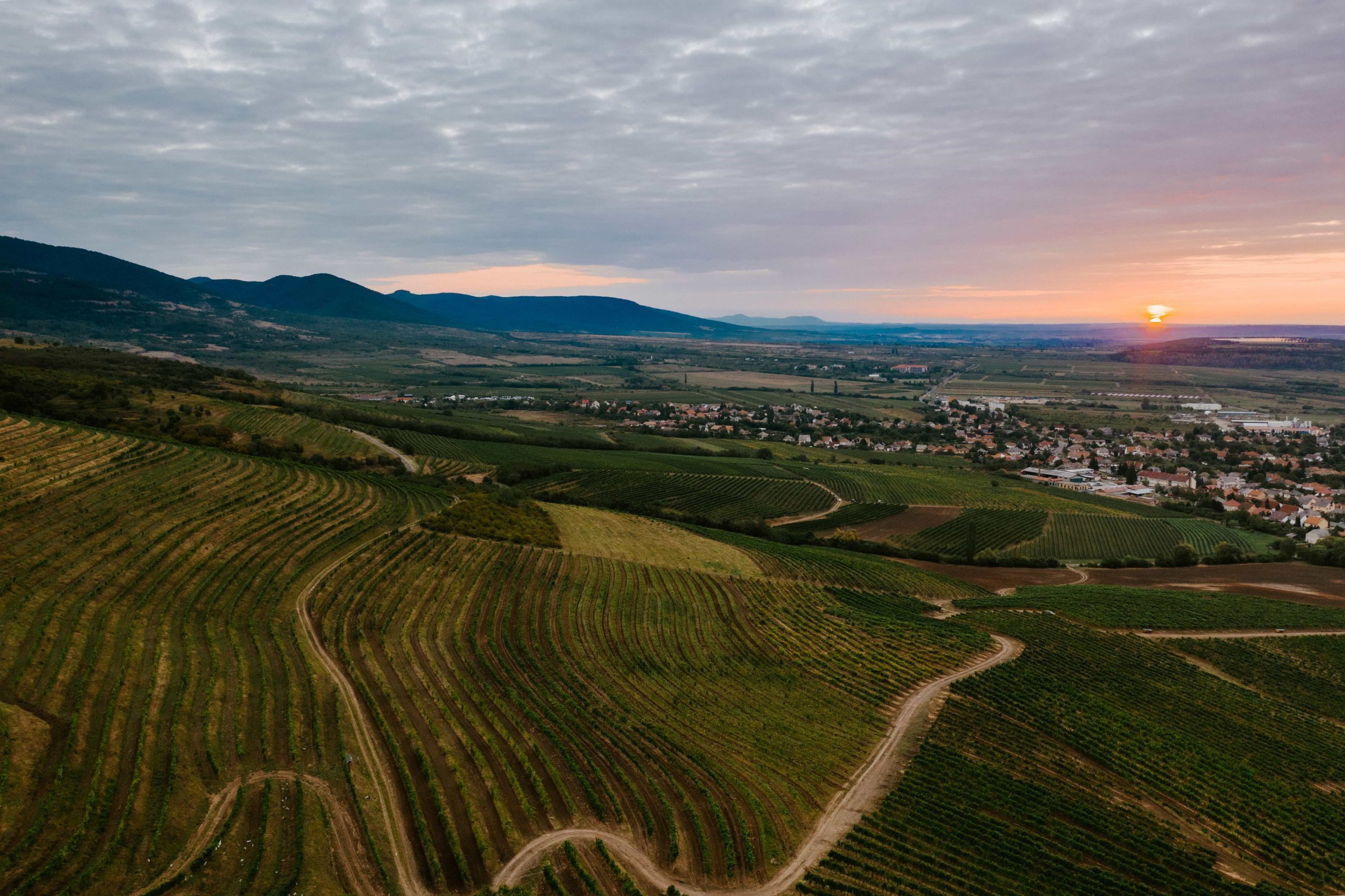
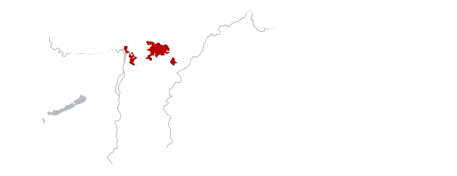
The Mátra wine district mostly covers the southern slopes of the Mátra Mountains, which give it its name, and is complemented by vineyards in the Heves area, the northern foothills of the Gödöllő Hills and certain isolated areas of the Cserhát Hills. In practice, this means that Vác and Szendehely to the north, as well as the area around Veresegyház and even Budapest-Rákosliget, are part of the Mátra wine region.
The Mátra region has a temperate mountain climate, but the vineyards are in a much more favourable position due to their lower altitude. During the growing season, the average temperature is around 17°C, with annual precipitation between 550 and 700 mm.
The Mátra is a volcanic mountain range in the inner zone of the Carpathians. Its main mass is composed of pyroxene andesite, andesite tuff and agglomerate. Approximately 19 million years ago, during several waves of active stratovolcanic activity, a series of eruptions began with dispersion of rhyolite tuff, followed by rhyolite lava and pyroxene andesite lava flows, and then the process ended with another dispersion of tuff. There are also traces of geysers that testify to post-volcanic activity, as their hydroquartzite material is very resistant.
At the end of the Miocene volcanism, several small rhyolite volcanoes were active on the southern edge of the mountain range, such as Kishegy in Gyöngyössolymos. The primary volcanic formations later eroded, river erosion formed valleys, and volcanic rocks (a small amount of rhyolite, more andesite) were mainly covered with loess, clay and limestone, which were then overlain with chernozem brown forest soils, brown forest soils with clay inflow and black erubase soils, but humus-rich Pleistocene sand and Holocene sand also occur in flat areas.
Vineyards
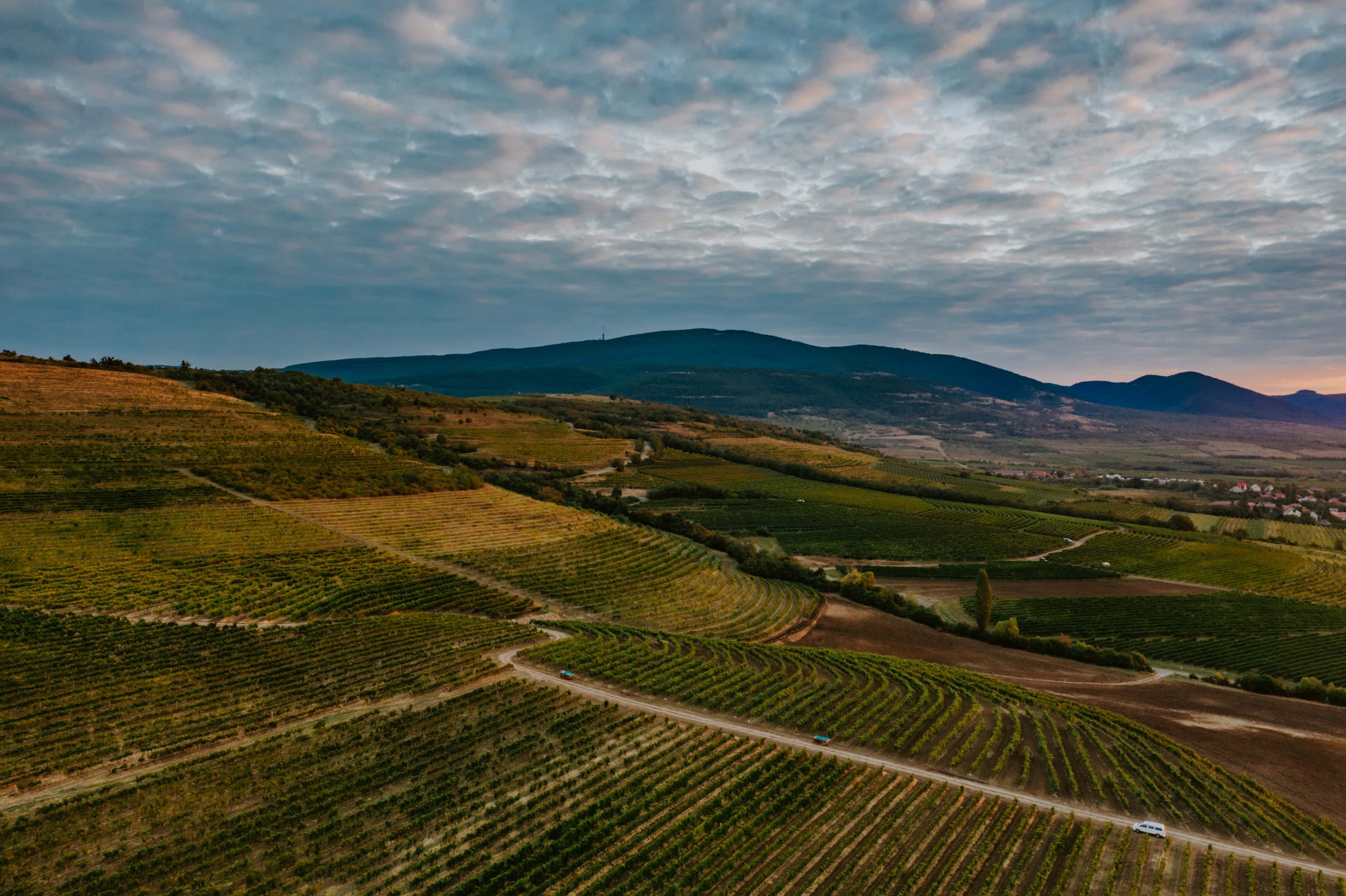
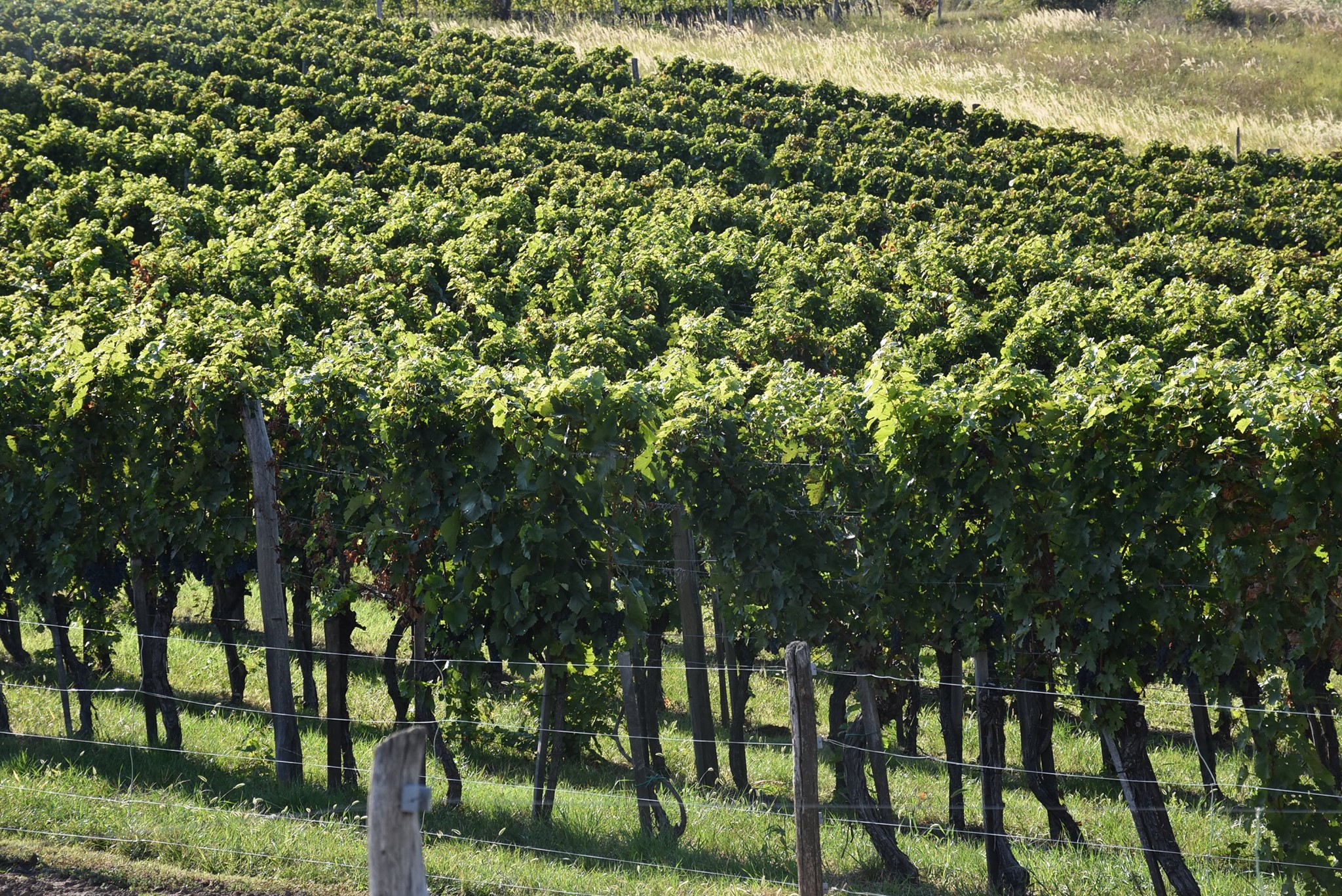
Most producers in the Mátra wine district do not focus on individual vineyards, but thanks to a few small producers, some Mátra vineyards have gained considerable recognition over the past decade. Let’s look at the most important ones. The Úrráteszi-dűlő is located on the border of Gyöngyöspata, at an altitude of 220-260 metres. It is a long stretch of land that begins on the northwestern side of the village and extends far into the Mátra Mountains. Its soil is black and rich in nutrients, and its climate is cool. It is important to note that before the introduction of origin protection, the ridge continuing northwest from Úrráteszi was called this throughout; currently, the middle section is referred to as Meggyes, while the upper section is called Ereszvény. Meggyes is therefore a completely new vineyard, its soil is much rockier than that of Úrráteszi, and the vineyards are also steeper. The soil is cut up and made varied by whitish volcanic tuff debris and limestone veins. It starts at an altitude of 260 metres and ends at an altitude of 330 metres. As previously mentioned, Ereszvény-dűlő is also an offspring of Úrráteszi. It lies at an altitude of 330-430 metres, but only its lower parts are covered with vineyards, while there are meadows surrounded by forests on its upper areas
In recent decades, Gereg was the name of a large area north of the village, but the new vineyard boundaries divided it into a multitude of small vineyards (Szedres, Fajzati-út, Gereg, Virág-domb, Borsos, Tamás-hegy, Acélos, Tehéntánc, Vár mege, Bódics, Szoros, Előmáj and Póc-tető). Gereg currently has good water management, with some andesite tuff mixed into the reddish, high-iron clay soil. There is constant air movement, but due to its southern exposure, it is much warmer than Úrráteszi. It is a well-known vineyard name, appearing on several labels.
In the past, Virág-domb, which lies at an altitude of 275-315 metres, was considered the best sub-vineyard in Gereg. It is an elongated rectangular area with southern and slightly southeastern exposure. It is protected by a mountain ridge to the north, and the wind blows constantly. High-iron clay is the main soil type here, as it is in Gereg, but there are also patches of calcareous soil.
The Cserepes vineyard stretches between 180 and 300 metres north of the road connecting Gyöngyöspata and Gyöngyös. The vines are planted at an altitude of 240 metres, but according to the product specification, the vineyard area is much larger. It has south-eastern exposure. Fay-domb is a 170-195-metre-high hill, bordered on the north by the road connecting Gyöngyöspata and Gyöngyös. It is an undulating area, mainly facing west and southwest. The subsoil is clay, and the topsoil is a mixture of loess, loam and brown forest soil.
Several wineries see serious potential in the Diós vineyard, which lies at an altitude of 185-260 metres, facing southeast. It is bordered by the Gyöngyöstarján access road to the south-southwest and one of the town’s streets to the east, but the higher areas are surrounded by forest like a basin. A small section borders Barnatanya-dűlő, a gently sloping, south-facing hillside and one of the best areas in Gyöngyöstarján. It lies 180-250 metres above sea level and consists of very stony brown forest soil mixed with some crumbly andesite tuff.
Epres is a new vineyard in Mátra, but many people may be familiar with it from previous vintages under the name Epreskert. It lies at an altitude of 220-260 metres on the flat ridge between Gyöngyöstarján and Gyöngyösoroszi, with slight southeasterly exposure. The soil is gravelly, with andesite subsoil underneath. It is a windy area, so there are no serious problems with fungal diseases.
Tavasz-föld is a 240-350-metre-high hill northwest of the village of Szücsi. There are a gully and a narrow strip of forest at the bottom, which provided the perfect opportunity to build a row of wine cellars near Szücsi. It borders Vitéz-föld on its western side. The soil is mainly brown forest soil, loam and clay. It is a well-known vineyard that also appears on labels. Vitéz-föld is a vineyard located 270-370 metres above sea level, west of the Tavasz-föld vineyard. It is mainly south-facing and bordered by forest on two sides. The soil is a fascinating mixture of weathered andesite, red clay, hydroquartzite and some limestone and opal.
Although it is not a vineyard (there are some on it), we must mention Sár Hill, which is not only the wine district’s but also one of the country’s most emblematic hills in terms of viticulture. The 500-metre-high peak, relatively isolated from the main massif of the Mátra, breaks off into the plain with a steep edge, bathed in sunlight from all directions. It is of volcanic origin, with lava flows on its western side. The bedrock is andesite, rhyolite tuff and andesite tuff, on which loess has been deposited on the southern foothills. The soil is mainly chernozem brown forest soil and clay-infiltrated brown forest soil. Nowadays, the designation of origin mentions several vineyards, starting on the Gyöngyös side with Farkasmály, then south of it with Sár-hegy-dűlő, followed by Szurdok-part, Lencse-máj, Rózsa-máj and Rókus.
Origin protection
The Mátra wine district established a strict set of rules in its first product specification in 2012. In addition to white, red and rosé wines, the concepts of late harvest, Siller and Muscat were also introduced, and vineyards in the wine district were divided into hundreds of plots. Following the 2016 amendment, it is now possible to produce superior white and superior red wines, which must have a minimum alcohol content of 12%. Moreover, the concept of sparkling wine was also included in the regulations. Another important change took place in 2019, when the wine district was effectively demarcated by making it impossible to produce wines outside the designated area.

















































































































































































































































































































































Events
Domestic and international wine programs